Showing posts with label tax questions. Show all posts

Tuesday, January 20, 2009

10 New Tax Laws You Need to Know

10 New Tax Laws You Need to Know
With each new year comes a new batch of tax rules and miscellaneous changes to the laws that taxpayers need to be aware of. There's no denying that the tax code in the United States is incredibly complex, and there are tons of changes.

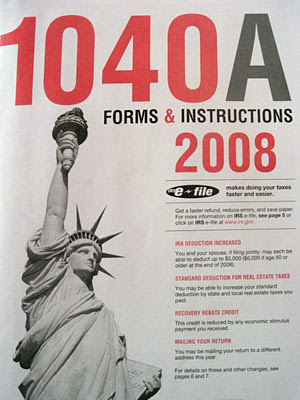
Recovery Rebate Credit

If you weren't eligible for an economic stimulus payment in 2008, you might still be able to get that money. The initial payments were based on your 2007 income, and if your income was too low or too high, you may have missed out. You can now use your 2008 income to collect, and the IRS is offering help in calculating whether you qualify.

AMT Exemption Increased

The Alternative Minimum Tax (AMT) is a law that was created to make sure high income earners didn't get out of paying income taxes. Now this rule is affecting more middle-income taxpayers, but the "bailout bill" upped the exemption amount for 2008 to spare more taxpayers from the AMT for one more year.

First Time Homebuyer Credit

If you bought your first home between April 9, 2008 and June 30, 2009, you might qualify for a new credit. Taxpayers can get up to $7,500 from the federal government, which has to be paid back over 15 years at a rate of $500 per year. It amounts to an interest-free loan from Uncle Sam that can help you get your first house.

Tax Relief for Midwest Disaster Areas

If you lived in certain Midwest states that were affected by severe storms, tornadoes or flooding that happened between May 19 and August 1, 2008, you can receive special tax breaks. The rules include reduced restrictions on casualty loss deductions and charitable contribution deductions. There is also an exemption available if you provided housing to a victim of these disasters.

Increased Contribution Limits for IRAs

The tax rules permit taxpayers to contribute to traditional IRAs and Roth IRAs if their income falls within certain parameters. If your income is too high, you are limited in these contributions. All of the limits increased for 2008, which means taxpayers with higher income might still be able to contribute.

Standard Mileage Rate Changed

The standard mileage rate for business use of your vehicle was 50.5 cents per mile for the first six months of 2008, and 58.5 cents per mile for the rest of the year. The rates also changed for miles driven for medical reasons or charitable purposes.

Capital Gains Taxes Lowered

Those with lower incomes will benefit from a reduction in the lowest capital gains rate. The formerly 5% rate for married taxpayers with income under $65,100 and single taxpayers with income under $32,500 has now been reduced to 0%.

Kiddie Tax Changes

The rules related to investment income of children have changed to include students between ages 18 and 24 who are not financially reporting themselves. A child with investment income greater than $1,800 must be taxed at the parent's tax rate to avoid shifting of investments to children to escape income taxes.

Required Minimum Distributions From IRAs

Retirees with tax-deferred retirement funds such as 401(k)s and IRAs are required to take minimum amounts out of those funds once they reach age 70 ½ . The government requires this because those amounts taken out are taxable on withdrawal, and it ensures the IRS gets something from retirees. Because of the stock market troubles, RMDs are suspended for 2009. That doesn't help when preparing 2008 taxes, but is important to note for planning for 2009.

Free Tax Help

Low income and elderly taxpayers have several options for free tax help. The most extensive option is the Volunteer Income Tax Assistance program. Qualified tax preparers volunteer their time to help answer tax questions and prepare basic tax returns. Taxpayers can also get assistance by calling the IRS or visiting one of their walk-in centers.

Thursday, December 11, 2008

Answers to 5 Big Questions About 2008 Taxes

FreeTaxUSA.com
Here are answers to some reader queries about taxes in a time of financial turmoil, as well as some additional tax-savvy moves to consider, including what to do if you have near-worthless stocks or bonds, or are planning major charitable donations but are short on cash.

Writing off your losers. Investors are allowed to offset capital gains and losses, with no limit. If your losses exceed your gains, you can deduct as much as $3,000 of net losses ($1,500 if married and filing separately) each year. Additional losses get carried over into future years.

Reader Herb Gregory of Palatine, Ill., asks whether there are any plans in Congress to increase the current net capital-loss limit. "With the current economic situation creating potential huge tax losses for individuals this year, it could easily be several years -- up to a lifetime -- before all losses can be utilized," he writes.

During the presidential campaign, Sen. John McCain proposed raising the net capital-loss limit to $15,000 a year. Then-Sen. Barack Obama didn't comment -- and still hasn't. So what are the odds Congress will change the law this year? "Pretty slim," says Clint Stretch, managing principal for tax policy at Deloitte Tax LLP. "Congress will have a hard time agreeing on any tax items before year end."

Fast and easy online tax filing

Separately, suppose you are considering selling stocks or bonds you bought years ago that are now trading for well below what you paid for them. Don't donate those losers to charity. Instead, consider selling them, using the losses to save taxes -- and then donate the proceeds to charity.

What do to with worthless stocks. What if you had the misfortune to invest in a company whose stock now is worthless or nearly worthless?

If a stock you bought for a taxable account became completely worthless during 2008, report it on Schedule D of Form 1040. Write "worthless" in columns (c) and (d), and enter the amount of your loss in parentheses in column (f). If you don't claim a loss for a worthless security on your original return for the actual year in which it became worthless, file what's known as an amended return for the year it became worthless. Use Form 1040X, available on the IRS Web site. You must file it within seven years from the date your original return for that year had to be filed, or two years from the date you paid the tax, whichever is later, the IRS says.

If the stock isn't completely worthless, consider asking your broker to buy those shares from you for a nominal amount, such as $1, so that you can clearly document your loss. Among those that will do so for clients is Vanguard Brokerage Services, says Rebecca Cohen, a Vanguard Group spokeswoman.

Changes in minimum-distribution requirements. During the presidential campaign, Mr. Obama called for major changes in the rules requiring millions of people 70½ or older to withdraw certain amounts of money from their retirement accounts. Several readers, including James M. Gleason of Rancho Palos Verdes, Calif., want to know if there's still any chance of action this year.

The short answer is yes. Although time is running short, it's still possible that Congress, the Treasury Department or both will take action. Many proposals are under consideration, including reducing how much taxpayers have to withdraw this year. Don't count on anything happening. But investors who haven't already made their full distributions for 2008 should consider delaying a little longer, just in case Washington delivers a last-minute Christmas package.

Speculation about possible changes rose last month when a Treasury official confirmed the department was studying the subject. A spokesman confirms the department is aware of the issue and is still looking into it.

But relief may not arrive until next year. Several leading senators recently proposed legislation that would place a one-year moratorium on required minimum distributions from retirement accounts, such as IRAs and 401(k)s, for 2009, a Senate Finance Committee staffer says. Among the sponsors are Senate Finance Committee Chairman Max Baucus (D., Mont.), Sen. Chuck Grassley (R., Iowa, the committee's ranking Republican member) and Sen. Ted Kennedy (D., Mass.). The legislation would "allow savings to stay put and avoid a tax hit when the market is down," a committee statement said.

Making a gift from your IRA. Meanwhile, some older taxpayers may benefit by taking advantage of a recently enacted law that extended the life of a popular provision that had expired. The law allows individuals age 70½ and older to make direct transfers of as much as $100,000 a year from an IRA to qualified charities without having to count those distributions as taxable income. What's more, the transfer counts toward the taxpayer's required minimum distribution. This provision has been extended through 2009.

"Not all charities are eligible," the IRS said in a statement issued Tuesday. "For example, donor-advised funds and supporting organizations are not eligible recipients."

Charging your charitable contributions. If you want to make a big gift to your favorite charity to nail down a deduction for your 2008 return, but don't have the cash to do it now, consider charging your gift to a credit card. As long as you charge your gift this year, you can deduct it for this year. "Contributions are deductible in the year made," the IRS said. "Thus, donations charged to a credit card before the end of the year count for 2008. This is true even if the credit card bill isn't paid until next year. Also, checks count for 2008 as long as they are mailed this year."